
Following its highly anticipated reopening in 2025, the annual Kailash Mansarovar Yatra (KMY) for the 2026 season officially started. The launch marks a critical milestone for international pilgrims, particularly due to the spiritual significance of the current year and the famous Saga Dawa festival. In the traditional calendar, 2026 is observed as the “Horse Year,” a sacred cycle that historically generates an exponential surge in global devotees seeking to perform the circumambulation (kora) of Mount Kailash.
To accommodate the expected influx, administrative frameworks at the border have undergone
significant structural adaptations. The Chinese government has taken deliberate steps to smooth the entry process for international travellers. Chief among these developments is the introduction of a formalised, more predictable Visa approval process. Observers and transit coordinators report that Visa permits are currently being issued on time, establishing a reliable timeline that has mitigated much of the logistical uncertainty historically associated with the high-altitude trans-border journey.
As private operators receive permits for the Nepal route, questions are naturally arising about standards of care on a journey that pushes the human body to its limits, altitudes between 15,000 and 17,500 feet, unpredictable weather across the Tibetan plateau, and limited infrastructure along much of the route.
Supporting the Communities That Make the Yatra Possible
What has drawn equal attention, perhaps less visibly but no less significantly, is what a private tour operator, Trip To Temples, has done beyond the pilgrim experience itself.
The five years of suspension took a quiet but severe toll on the local Nepali and Tibetan communities whose livelihoods depend almost entirely on the Yatra season. Ponymen, local shopkeepers, guides, and support staff who serve pilgrims along the route saw their primary source of income effectively disappear during the COVID years. With no pilgrims passing through, there was little else to fall back on.
Ahead of the 2026 revival, this private tour operator undertook a ground-level initiative to support these communities. The company distributed bedsheets at and warm jackets to ponies, saddle covers for the ponies suited to the harsh mountain conditions, and water bottles to local shops along the route, practical supplies chosen with direct relevance to the work these communities do.
The gesture is modest in scale but deliberate in intent. A pilgrimage of this nature runs on an ecosystem of people who carry the elderly and the exhausted, shopkeepers who provide essentials at altitude, and local staff who keep the route functional. Strengthening that ecosystem, particularly after years of economic standstill, is as much a part of responsible pilgrimage operations as anything that happens on the trail itself.
It also reflects a broader understanding: that sustainable spiritual tourism cannot exist in isolation from the communities it passes through.
Challenges And Demanding On-Ground Realities
The Kailash Mansarovar Yatra 2026 season brings an unusually high-pressure environment. The rare convergence of the Horse Year with the sacred Saga Dawa Festival has triggered an unstoppable surge in yatri arrivals, stretching existing infrastructure beyond limits. Guesthouses along the parikrama route are operating beyond capacity, while transit management in narrow mountain corridors remains a persistent challenge. The Tibetan Plateau’s unpredictable weather- sudden snowfall, sub-zero temperatures, and fierce glacial winds, etc., adds another layer of difficulty. At altitudes exceeding 15,000 feet, even the well-prepared face the physical risks, making on-the-ground logistical support a necessity, not a luxury.
What Pilgrims Can Now Expect with Kailash Yatra 2026?
One operator is drawing attention in many ways this season. Trip To Temples, which has long specialised in the Kailash Mansarovar Yatra. For 2026, the company has made a notable push to address practical challenges that have historically made the journey harder than necessary, particularly for older pilgrims and women.
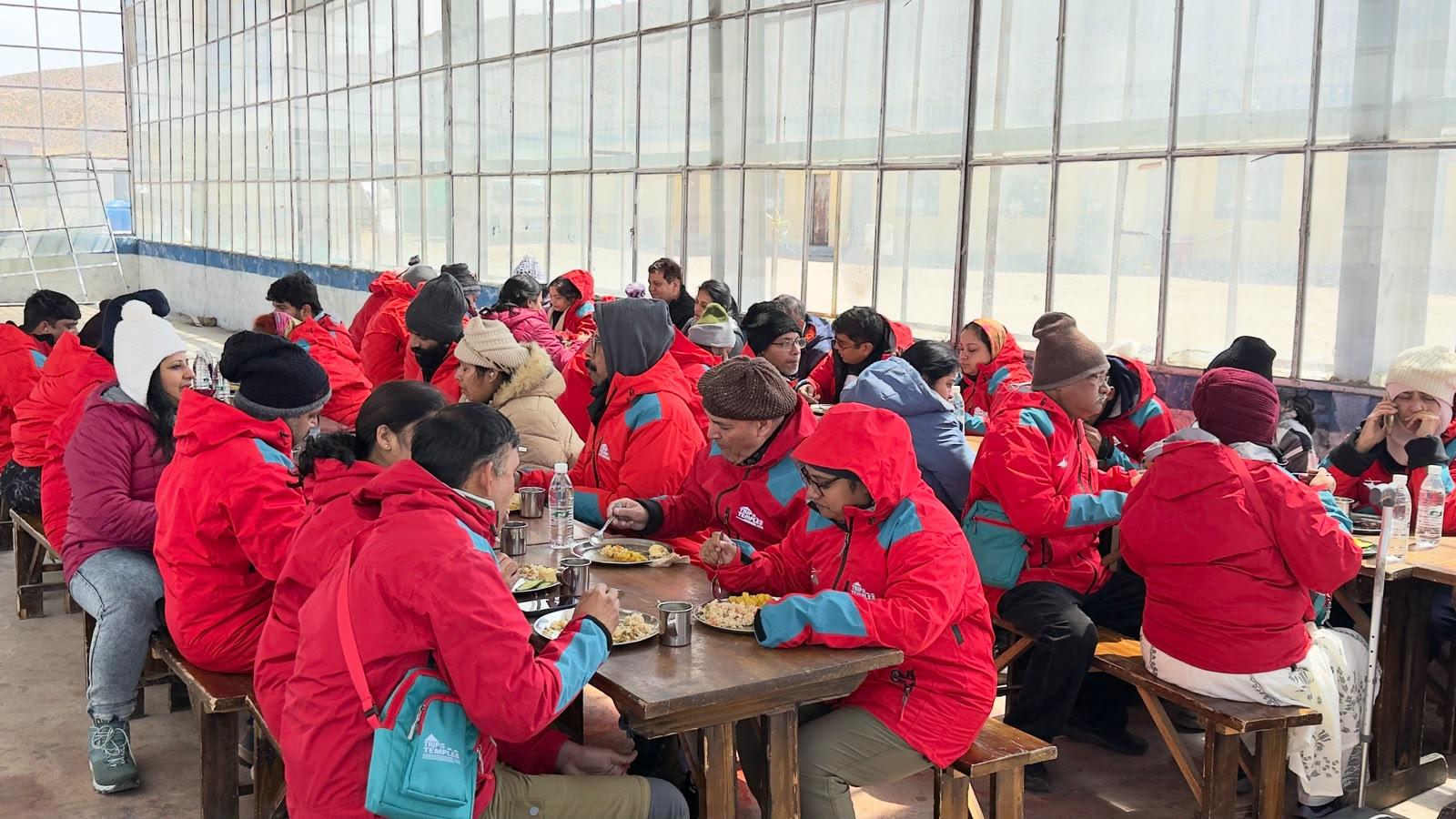
Among the provisions being offered are portable toilets, changing tents at Mansarovar Lake for those taking the sacred dip, portable chairs for rest stops, high altitude jackets, drinking bottles, and much more to their clients.
These may sound like small details, but on a pilgrimage of this physical and spiritual intensity, they address longstanding gaps. The absence of proper sanitation facilities along the route, for instance, has been a documented concern for women pilgrims for years.
What is notable about Trip To Temples’ approach is that many of these additions were not conceived in a boardroom — they emerged from systematic feedback collected after each pilgrimage. The company describes its operating philosophy using the Japanese concept of Kaizen, or continuous improvement: every journey is reviewed, shortcomings are corrected, and working elements are refined before the next group departs.
The result is an operator whose returning pilgrims are among its most credible advocates.
