

Indian higher education is undergoing a significant transformation. For decades, universities and colleges were assessed primarily on the basis of infrastructure, faculty strength, academic processes, and compliance with prescribed standards. While these parameters remain important, the discourse around quality assurance is increasingly shifting towards outcomes, institutional effectiveness, and societal impact.
This transition aligns with the broader vision of the National Education Policy (NEP) 2020, which emphasizes multidisciplinary education, flexibility, innovation, research, skill development, and improved learning outcomes. As higher education institutions adapt to changing academic and economic realities, quality assurance mechanisms are also evolving to focus not only on what institutions possess, but on the value they create for students and society.
Historically, accreditation systems played a crucial role in establishing quality benchmarks across institutions. These frameworks encouraged institutions to develop infrastructure, strengthen governance, improve teaching-learning processes, and maintain academic standards. However, over time, concerns emerged regarding excessive emphasis on documentation and procedural compliance, often at the expense of continuous quality enhancement and measurable outcomes.
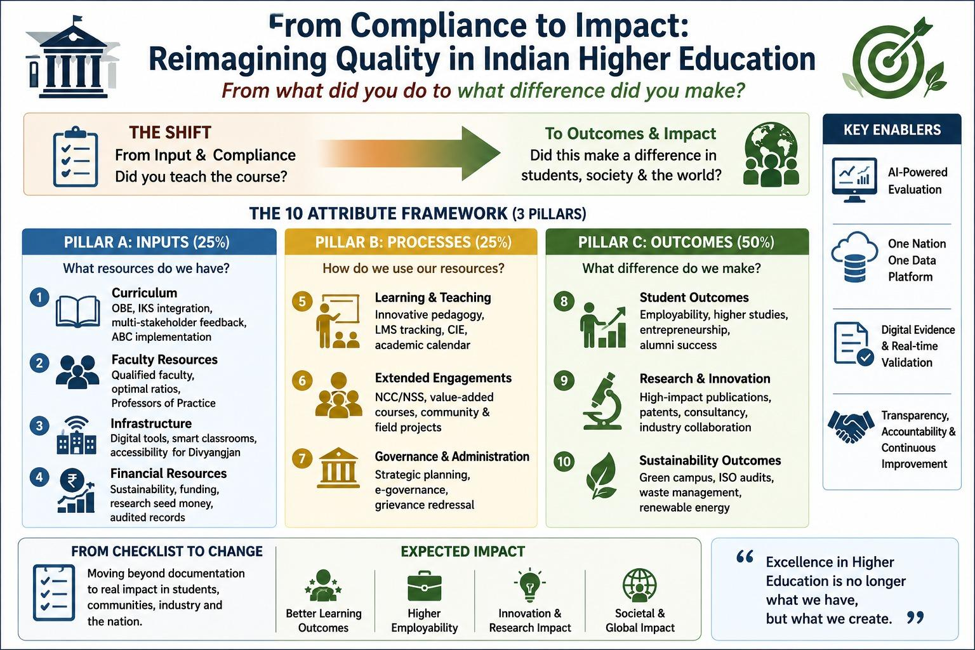
Recent discussions around higher education accreditation reforms indicate a growing preference for evidence-based evaluation models that place greater emphasis on institutional performance, student progression, employability, research quality, innovation, and community engagement. Proposed accreditation frameworks have also explored organizing assessment parameters around broader dimensions such as inputs, processes, and outcomes to provide a more comprehensive understanding of institutional effectiveness.
In this emerging landscape, institutional inputs continue to remain important. Curriculum design, faculty competence, infrastructure, learning resources, financial sustainability, and technological readiness form the foundation of educational quality. Simultaneously, institutions are increasingly expected to demonstrate how these resources are utilized through effective teaching-learning practices, governance mechanisms, student support systems, and community engagement initiatives.
The growing focus on outcomes represents perhaps the most significant shift in quality assurance thinking. Student progression, employability, entrepreneurship, research productivity, innovation, industry collaboration, and societal contribution are receiving increasing attention as indicators of institutional performance. Such measures provide a more holistic understanding of how educational institutions contribute to national development and knowledge creation.
Technology is also becoming an important enabler of quality assurance. Digital platforms, institutional databases, learning management systems, and data-driven monitoring mechanisms are helping institutions improve transparency, documentation, and decision-making processes. The integration of digital records and evidence-based reporting has the potential to enhance consistency and reduce subjectivity in quality assessment.
These developments have important implications for Internal Quality Assurance Cells (IQACs). Traditionally viewed as accreditation support units, IQACs are increasingly expected to function as institutional quality management centers that facilitate continuous monitoring, data validation, performance analysis, and strategic improvement initiatives throughout the year.
The changing quality landscape also places new expectations on faculty members. Excellence is no longer viewed solely through teaching workloads or publication counts. Greater attention is being paid to innovation in pedagogy, student mentoring, research quality, industry engagement, community outreach, and contributions to institutional development. Continuous professional development is therefore becoming an essential component of academic excellence.
Research and innovation remain central to the future of higher education. Institutions are increasingly encouraged to promote meaningful research, interdisciplinary collaboration, industry partnerships, intellectual property creation, and solutions to societal challenges. The emphasis is gradually shifting from quantity-driven metrics toward quality, relevance, and impact.
Another emerging dimension of quality assurance is sustainability. Educational institutions across the world are recognizing their responsibility toward environmental stewardship and sustainable development. Resource conservation, green campus initiatives, waste management practices, renewable energy adoption, and sustainability education are becoming increasingly relevant indicators of institutional responsibility and long-term resilience.
At the same time, successful implementation of outcome-oriented quality systems requires addressing several challenges. Institutions vary significantly in terms of resources, digital infrastructure, geographical context, and academic missions. Capacity building, technological readiness, data governance, cybersecurity, and stakeholder engagement will be critical to ensuring that quality assurance reforms remain inclusive and equitable.
Ultimately, the future of quality assurance in Indian higher education lies in balancing accountability with institutional autonomy, and compliance with continuous improvement. The objective should not merely be to satisfy regulatory requirements but to create meaningful educational experiences, generate knowledge, foster innovation, and contribute to societal progress.
As India aspires to strengthen its position in the global knowledge economy, the true measure of institutional excellence will increasingly be reflected in the outcomes achieved, the opportunities created for learners, and the impact generated for society. The conversation around quality assurance is therefore moving beyond compliance toward a broader and more meaningful understanding of educational effectiveness.
Dr. Sunil Goyal
The author is an eminent social scientist, professor, and columnist presently associated with the Department of Higher Education, Government of Madhya Pradesh.
(Disclaimer: The views expressed are personal and do not necessarily reflect those of the Department of Higher Education, Government of Madhya Pradesh or any government authority.)
